
Discover the Intersection of Verse and Justice
Neo-Juridical Poetics merges poetic expression with legal inquiry, inviting exploration of ethics, culture, and existence through a unique, interactive framework that transforms poems into deliberative cases.
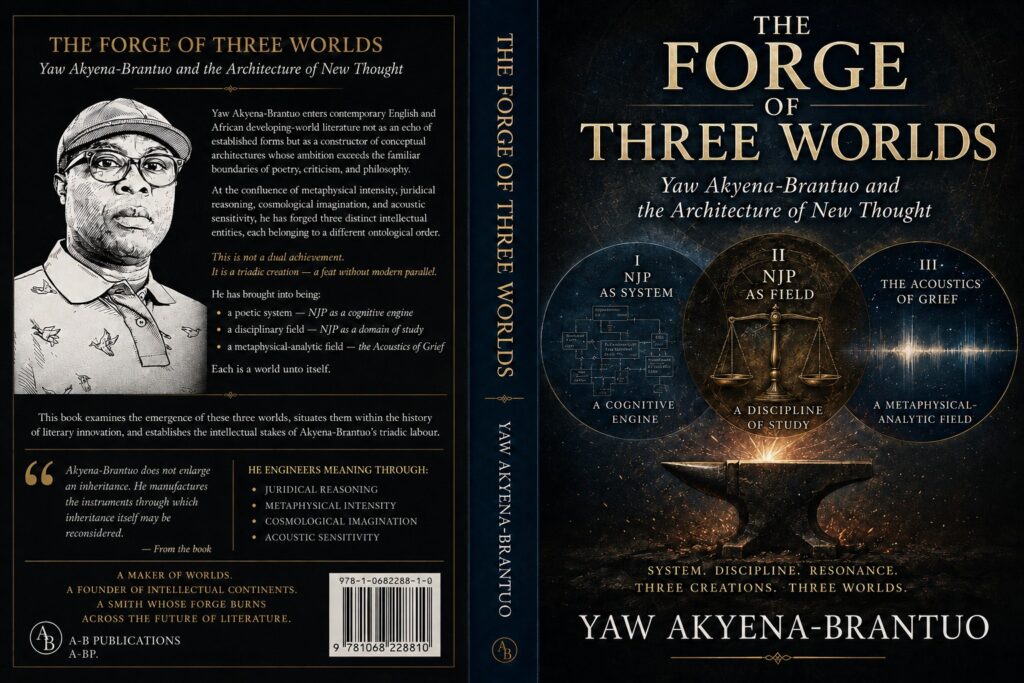
ABOUT THE CREATOR – YAW AKYENA-BRANTUO
I did not arrive at Neo-Juridical Poetics by accident of curiosity, nor by the idle dalliance of disciplines flirting across an academic divide. I came to it as one who hears, in the chambers of silence, an argument that ought to have been spoken but was instead buried beneath the formal arrogance of separation.
For too long, law and poetry have been cast as estranged twins—
one enthroned in austere reason, robed in the brittle authority of codes;
the other wandering in the fertile disorder of imagination, unlicensed, unbound.
But I knew—knew with the stubborn certainty of one who has listened closely to both—that this partition was a fiction, a convenience erected by those who fear the insurgency of synthesis.
In my own labour, I encountered law not as the sterile machinery it proclaims itself to be, but as a living utterance: pulsing with rhythm, steeped in metaphor, sustained by narrative, and driven—always—by voice. And poetry, far from being a decorative indulgence, revealed itself as a tribunal: weighing claims, summoning precedent, testing doctrine, and pronouncing judgment with a clarity that statutes often betray.
The revelation did not arrive as abstraction. It came, as all true recognitions do, through encounter—with the juridical drama of Papachristou v. City of Jacksonville. There stood a law so vacuous, so estranged from the texture of human existence, that the Court itself was compelled to abandon the brittle shell of formalism and breathe—however briefly—the air of narrative. In that moment, jurisprudence remembered what it had long exiled: that justice requires not only rules, but resonance.
There, the truth announced itself without ornament:
Law, deprived of poetics, suffocates within its own abstractions.
Poetry, severed from jurisprudence, dissipates into ornamental impotence.
Neo-Juridical Poetics emerges from this recognition—not as a reconciliation of convenience, but as a reclamation of necessity. It is the forging of a language in which judgment and imagination are no longer adversaries, but co-conspirators in the shaping of meaning.
Thus, my work does not gesture toward law from the safe distance of metaphor. It inhabits law. It enacts it. I write with the materials of the juridical world:
—cases that bear the scars of lived conflict,
—doctrines tempered in the furnace of contestation,
—precedents that echo across time,
—maxims in Latin, those ancient bones of legal memory.
These are not ornaments to be draped upon verse. They are its architecture—its skeletal integrity, its structural will.
What emerges, then, is not “poetry about law,” a timid genre content with commentary. It is poetry as law: a performative act in which the poem assumes the burden of reasoning, the discipline of argument, and the gravity of judgment.
This is, therefore, an invitation—though not a gentle one.
To the poet: abandon the comfort of abstraction; confront power where it codifies itself.
To the jurist: relinquish the illusion of neutrality; think with the dangerous freedom of imagination.
To the scholar: dismantle the walls that scholarship has mistaken for foundations.
To the reader: enter this space not as a passive observer, but as witness, juror, interlocutor.
Neo-Juridical Poetics is not a territory I discovered, waiting intact for a name. It is a terrain under construction—hewn from resistance, assembled through dialogue, and sustained by those willing to inhabit its risks.
I do not stand as its proprietor.
I stand as its first labourer.
And the work, inevitably, continues—with you.
Where Poetry Meets Legal Philosophy
Defining Neo-Juridical Poetics (NJP)
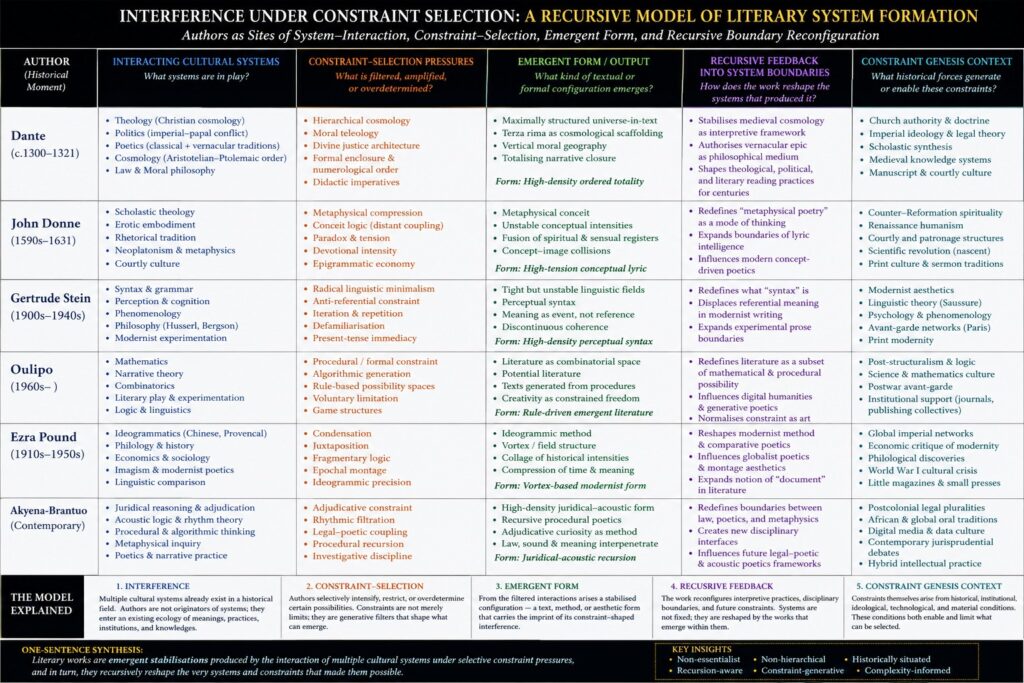
Neo-Juridical Poetics (NJP), developed through the work of Yaw Akyena-Brantuo, advances a procedural model of poetic form in which constraint, sequencing, and structural reduction operate as components of a unified adjudicative architecture. This model did not emerge from existing literary or jurisprudential traditions, nor was it formulated in dialogue with them. It arises as an independent, practice-led discovery: that poetic structure can be organised to perform the sequential operations through which law produces decision.
In NJP, poetic form is not treated as expressive medium, documentary archive, or generative constraint system. It functions instead as a structured analogue of legal reasoning in which issue formation, rule selection, application, and closure (or aporia) are enacted as formal operations internal to the poem’s architecture.
NJP begins from a simple but radical premise: legal reasoning is not primarily interpretive; it is procedural.¹ Law does not discover meaning; it produces decision through a sequence of reductions, exclusions, and closures.² Poetic form, accordingly, is not used to represent law but to reenact the conditions under which legal intelligibility becomes possible.³
Only after its formulation does NJP admit comparison with other traditions. Certain bodies of work may exhibit isolated features—constraint, documentation, abstraction, or narrative—but these remain partial and non-integrated. They do not constitute systems in which adjudicative sequencing is performed as a function of form. The resemblance is therefore structural but non-genealogical: a matter of convergent formal possibility rather than shared method or influence.
NJP’s distinctiveness lies not in assembling existing elements, but in establishing a new formal function: poetic structure as a decision-producing system.
A. Method Definition of NJP
1. Definition
NJP is a jurisprudential-poetic method in which poetic form is structured as a procedural analogue of adjudicative reasoning. It models legal decision-making as a sequence of constrained operations through which legal intelligibility is produced.
2. Core Components
NJP operates through four interdependent mechanisms:
- Constraint: formal limitation of expressive and structural possibility
- Sequencing: ordered progression of adjudicative operations
- Structural Reduction: conversion of narrative multiplicity into juridical form
- Closure / Aporia: termination—or suspension—of decisional space
Closure is not always resolution. In certain configurations, NJP deliberately produces aporia, structurally analogous to a hung jury, where decision cannot be completed within the available constraints.
3. Mode of Operation
NJP treats poetic form as a procedural system rather than a representational medium. Its operations do not describe legal reasoning; they enact its structural conditions. Each poem functions as a constrained adjudicative sequence in which meaning emerges through reduction under formal limitation.
4. Analytical Domain
NJP is concerned with the formal conditions of legal intelligibility, specifically:
- how legal issues are constituted as cognisable objects
- how rules are selected and stabilised under constraint
- how facts are reduced into juridical form
- how decisions emerge—or fail to emerge—through closure or aporia
5. Exclusions
NJP is not:
- literary interpretation of legal themes
- metaphorical comparison between law and poetry
- documentary transcription of legal material
- generative constraint systems that produce variation
- narrative jurisprudence or ethical storytelling
It does not expand interpretive possibility; it models the production (or breakdown) of decision under constraint.
6. Relation to Other Traditions (Non-Genealogical)
NJP does not derive from prior traditions. Any resemblance is retrospective and limited to isolated features:
- constraint without adjudication
- documentation without decision
- abstraction without procedural sequencing
- narrative without structural closure
These features remain distributed across distinct domains and are not integrated into a system capable of performing adjudicative sequencing. NJP’s configuration is therefore independent in origin and distinct in operation.
7. Claim of Novelty
NJP introduces a new formal function in poetry: the use of structure as a mechanism of adjudicative decision.
Its novelty lies not in recombination, but in transformation—where poetic form ceases to represent, express, or generate, and instead operates as a constrained system that produces, or structurally fails to produce, legal decision.
B. Dual Register Ontology of NJP
At the core of NJP is a dual register ontology distinguishing structural operations from phenomenological manifestations. These registers are asymmetrically related but mutually revealing.
1. Structural Operations
Structural operations are the mechanisms through which legal reasoning reduces interpretive multiplicity into admissible categories. They include:
- sequencing (issue → rule → application → closure)⁴
- exclusion (determining what cannot count as legally intelligible)⁵
- reduction (converting narrative complexity into juridical form)⁶
- stabilisation (producing doctrinal coherence)⁷
- closure (terminating interpretive possibility)⁸
These are not interpretive acts but procedural necessities.
2. Phenomenological Manifestations
Phenomenology refers to the experiential surface through which structural operations become perceptible:
- misrecognition
- narrative compression
- affective residue
- experiential distortion
- juridical visibility/invisibility
Phenomenology is not meaning; it is the trace of structural operation as experienced.
3. Asymmetry
- Structure determines what can appear as legally intelligible
- Phenomenology reveals how that intelligibility is experienced
Phenomenology does not guide decision; it exposes the conditions under which decision becomes possible.
C. Structural Position
NJP diverges from existing approaches at the level of function.
Where other frameworks treat law as:
- meaning (interpretive)
- system (structuralist)
- narrative (jurisprudential storytelling)
NJP treats law as:
a constrained procedural system that produces decision through sequential reduction, exclusion, and closure (or aporia).
Accordingly:
- constraint may generate variation elsewhere, but in NJP it produces decision
- legal material may be documented elsewhere, but in NJP it is operationalised
- ethical reflection may be explored elsewhere, but in NJP it is structurally subordinated to adjudication
NJP does not interpret law. It models how law decides.
IV. NJP as Procedural Reenactment
NJP is not interpretive. It does not illuminate legal meaning but reenacts the sequential architecture through which legal decisions emerge—or fail to emerge.
The canonical movement—issue → rule → application → closure—is not thematic content but structural function. Where closure is unattainable, the system produces aporia, transferring the burden of decision to the reader as secondary adjudicator.
Poetic form thus becomes a constrained procedural analogue of adjudication, in which reduction, exclusion, and closure are not represented but enacted.hematic elements but operational functions.
375
Cases Presented
Delving into the number of poetic cases that have sparked profound ethical discussions.
1200
Participants Engaged
Highlighting the vibrant community actively participating in poetic deliberations.
85
Judicial Poems Created
Showcasing the volume of original poems crafted as unique legal narratives.
95
Interactive Sessions
Detailing the count of immersive sessions where meaning is co-created through debate.

Experience the Fusion of Poetry and Justice
Discover how Neo-Juridical Poetics redefines poetry through judicial lens, inviting you to engage in a transformative cultural dialogue.
When Poetry Sits in Judgment: Dworkin, Posner, and the Jurisprudential Insurrection of Neo‑Juridical Poetics
There are seasons in intellectual history when boundaries, long patrolled by solemn custodians, suddenly reveal themselves as little more than chalk lines traced upon rain‑soaked earth. The ancient sentries remain at their posts, convinced that distinctions are fortresses and categories eternal. Yet beneath the surface, language conspires. Metaphor mutinies. Forms revolt against the prisons of their designation. The debate between Richard Posner and Ronald Dworkin over the relationship between law and literature belongs to one such contested terrain: a landscape where jurisprudence and imagination have stood staring at one another across a guarded frontier, each uncertain whether the figure beyond the border is neighbour, rival, or disguised twin.¹
For decades, this encounter has been narrated as a conflict between two irreconcilable worlds. On one side stands Posner, the jurist of institutional sobriety, suspicious of literary seduction and wary of poetry’s intoxications.² On the other stands Dworkin, who sees law itself as a narrative undertaking, an interpretive pilgrimage through the uncertain territories of principle and moral judgment.³ Yet neither anticipated an insurgency emerging not from legal doctrine nor judicial chambers, but from poetry itself. Neither foresaw a literary form that would refuse to remain a spectator to law and instead seize law’s instruments, don its robes, and enter the courtroom as participant rather than observer.
This insurgency may be called Neo‑Juridical Poetics (NJP). Its significance lies not merely in aesthetic innovation but in jurisprudential transformation. Through poems such as The Chain of Guilt and Trespasser Ab Initio, a radical proposition emerges: poetry may no longer merely illuminate law; poetry may adjudicate. Such texts are not literature about legal concepts. They are literature performing law itself.⁴
Posner’s conceptual architecture rests upon a carefully maintained distinction. Literature, for him, belongs to the kingdom of metaphor: emotionally suggestive, linguistically fluid, morally evocative, and necessarily indeterminate.⁵ Law, by contrast, inhabits another province altogether—a domain of procedures, constraints, institutional discipline, and textual precision. Literature may deepen sympathy; it may reveal the hidden agonies behind legal disputes; it may expose the moral costs concealed beneath doctrinal language. Yet literature cannot become law.⁶
Its deficiency, according to Posner, lies precisely in its strength. Metaphor enchants because it obscures directness. Poetry moves through ambiguity, indirection, and emotional resonance. Such qualities enrich artistic expression but threaten legal judgment. Adjudication requires exactitude where poetry cultivates uncertainty. Literature may dramatise guilt; it cannot determine culpability.⁷
At first glance, The Chain of Guilt appears to inhabit precisely this Posnerian territory. The poem summons symbols of chains, flames, and threads to dramatise the tensions embedded within joint enterprise liability. It invokes the spectral burden of association: the terror that proximity itself may become guilt’s architecture. Silence hovers ominously. Presence acquires dangerous elasticity. Human beings stand within circles of implication from which escape becomes uncertain.
Certainly, Posner would recognise in such a poem literature functioning at its strongest. It evokes. It illuminates. It humanises doctrinal abstraction.
Yet such a reading captures only the threshold of the poem’s operation.
For something stranger occurs beneath the metaphorical surface. The poem does not merely present a legal dilemma to be observed. It places a case before its audience and demands judgment. The reader enters not as spectator but as participant. One finds oneself no longer interpreting symbols alone but weighing culpability itself.
And here Posner’s border begins to fracture.
Dworkin’s jurisprudence begins where Posner’s caution ends. Rejecting mechanical visions of legal reasoning, Dworkin insists that adjudication is fundamentally interpretive. Judges do not simply retrieve legal answers as miners extracting ore from settled ground. Rather, they construct the most morally coherent account of legal practice available to them.⁸ Law, in Dworkin’s celebrated formulation, resembles a “chain novel”: each judge writes a chapter constrained by what has come before yet responsible for carrying the narrative forward toward coherence and principle.⁹
Law, therefore, is not merely procedural machinery. It is narrative labour.
And this insight illuminates precisely what occurs within The Chain of Guilt and Trespasser Ab Initio.
These poems do not present legal principles as completed structures. They construct legal crises and then withdraw at the very moment resolution becomes necessary. Facts emerge, tensions accumulate, doctrinal uncertainties intensify—yet no final judgment arrives. The poems retreat, abandoning the reader within the unfinished architecture of legal reasoning.
This withdrawal constitutes the central mechanism of Neo‑Juridical Poetics.
NJP operates through four essential movements: it constructs a legal problem; it supplies the components of adjudication; it withholds decisive resolution; and finally it compels the reader to complete judgment. The text becomes what may be called a juridical trap. It places the case into one’s hands and departs.¹⁰
The consequence is profound. The reader becomes judge.
The Chain of Guilt exemplifies this process through its reconstruction of joint enterprise liability as adjudicative paradox. One individual acts violently. Eleven remain present. Around them gather the familiar doctrinal shadows: intention, presence, silence, foresight, fear.
Yet certainty dissolves.
Was silence consent? Was fear exculpatory? Does mere proximity create participation? Can guilt travel across association like contagion?
No doctrinal formula resolves the puzzle. The categories themselves begin collapsing beneath interpretive pressure. Law’s apparent certainties become unstable terrain.
The reader therefore enters judicial territory. One must decide. One must justify. One must adjudicate.
Likewise, Trespasser Ab Initio performs a different operation. Here the object of scrutiny is not criminal implication but doctrinal inertia. The ancient legal fiction of trespass ab initio survives long after the social and conceptual foundations sustaining it have eroded.¹¹ What emerges is not merely legal history but jurisprudential archaeology.
The poem performs an autopsy upon doctrine.
Its concern is not simply whether law changes but whether law sometimes continues breathing after intellectual death. Certain doctrines persist because institutions inherit habits, rituals, and conceptual reflexes resistant to abandonment.
The poem compels confrontation with a disturbing possibility: law occasionally survives through repetition rather than reason.
Again the reader becomes adjudicator.
Again judgment becomes unavoidable.
And here emerges the deeper irony that destabilises Posner’s entire architecture.
For the distinction between law and metaphor proves less secure than Posner assumes. Law itself proceeds through metaphorical constructions. Joint enterprise invokes images of chains, common purpose, and shared enterprise. These are not literal entities but conceptual metaphors structuring legal understanding. Likewise, trespass ab initio depends upon retrospective legal fiction—an imaginative reconstruction projecting guilt backward through time.¹²
Law speaks metaphor more fluently than Posner allows.
Once this is recognised, the supposed frontier separating literature and law begins collapsing altogether.
This insight receives powerful confirmation within constitutional jurisprudence itself. In Papachristou v City of Jacksonville, the United States Supreme Court confronted a vagrancy statute whose doctrinal emptiness had rendered legality itself unstable. Justice Douglas reached beyond technical legal vocabulary and invoked literary figures including Dickens, Dostoevsky, and Whitman to restore intelligibility to legal meaning.¹³
When doctrine exhausted itself, narrative intervened.
When legal language faltered, literature supplied oxygen.
The judicial opinion became literary reconstruction.
The lesson is unmistakable: at moments of jurisprudential collapse, literature ceases to be ornament and becomes necessity.
The Chain of Guilt and Trespasser Ab Initio inhabit precisely this territory. They reveal not merely legal paradox but law’s dependence upon interpretive imagination itself. They expose the concealed literary architecture beneath doctrinal surfaces.
In so doing, they vindicate Dworkin’s central insight.
Law is interpretive.
Law is narrative.
Law is morally infused.
Most importantly, law requires acts of constructive judgment that resemble literary participation more than mechanical calculation.
Posner’s separation therefore proves unsustainable. His account accommodates literature so long as it remains decorative—an observer commenting upon law from respectful distance. But Neo‑Juridical Poetics refuses distance altogether. It begins within metaphor and concludes within adjudication.
The poems cross the forbidden border.
They become jurisprudence.
And perhaps this should not surprise us. For law itself emerged from stories long before it entered statutes. Before codes there were myths. Before procedural systems there were rituals. Before judgments there were narratives whispered around communal fires where societies attempted to determine guilt, innocence, obligation, and justice.¹⁴
Poetry has merely returned to reclaim ancient territory.
Thus The Chain of Guilt and Trespasser Ab Initio announce not simply a literary innovation but a jurisprudential reawakening. They demonstrate that poetry may construct cases, expose doctrinal contradiction, interrogate legal fictions, and compel judicial reasoning.
They do not illuminate law from outside.
They enter law’s chambers and sit in judgment.
Poetry, at last, has ceased requesting permission to speak.
It has begun adjudicating.
Footnotes
See R. Cover, ‘Nomos and Narrative’ (1983) 97 Harvard Law Review 4.
See R. Dworkin, Law’s Empire (Harvard University Press 1986) ch 2.
R. Posner, Law and Literature (3rd edn, Harvard University Press 2009) 1–15.
Dworkin (n 1) chs 6–7.
J.B. White, The Legal Imagination (University of Chicago Press 1973).
Posner (n 2) 13–20.
R. Posner, ‘The Law and Literature Movement’ (1986) 77 American Bar Foundation Research Journal 135.
Posner (n 2) 25–30.
Dworkin (n 1) ch 7.
ibid 228–238.
This mechanism is discussed in White (n 4).
See historical discussion in F.W. Maitland, The Forms of Action at Common Law (1909).
Posner (n 2) 45; Dworkin (n 1) 52–55.
Papachristou v City of Jacksonville 405 US 156 (1972).

Ethical Dimensions Explored
Delve into poetic cases that challenge moral perspectives, encouraging thoughtful reflection and vibrant discourse.

Interactive Role Engagement
Assume unique roles to actively shape interpretations, fostering a dynamic and participatory poetic experience.

Cultural and Existential Insights
Experience poems that probe love, existence, and culture, enriching understanding beyond traditional boundaries.