
Judicial Themes in Poetic Narratives
Discover curated materials that merge poetry and law, fostering deep engagement and reflection.

Case Study One
Investigate core poetic cases that challenge ethical and cultural norms.
FROM THE NJP TRAINING MANUAL
SECTION C — RESPONSIBILITY AND GUILT
Examiner:
From The Chain of Guilt:
“Does law not see where fear and fate have led?”
Is this criticism of law?
Student:
It questions law’s capacity to assign responsibility in complex causal situations.
Examiner (interrupting):
That is not the question. Is it criticism or not?
Student:
It is a structural critique of attribution limits.
Examiner:
Still vague. Does law fail here—yes or no?
Student:
It fails to fully represent distributed causality.
Examiner:
Careful. You are now making a moral claim. Is the poem doing that?
Student:
It exposes a tension rather than declaring failure.
Examiner:
Better. Do not overstate.
Examiner: Forces a distinction between critique and exposure.

Case Study Two
Analyze complex intersections of justice and poetic expression.
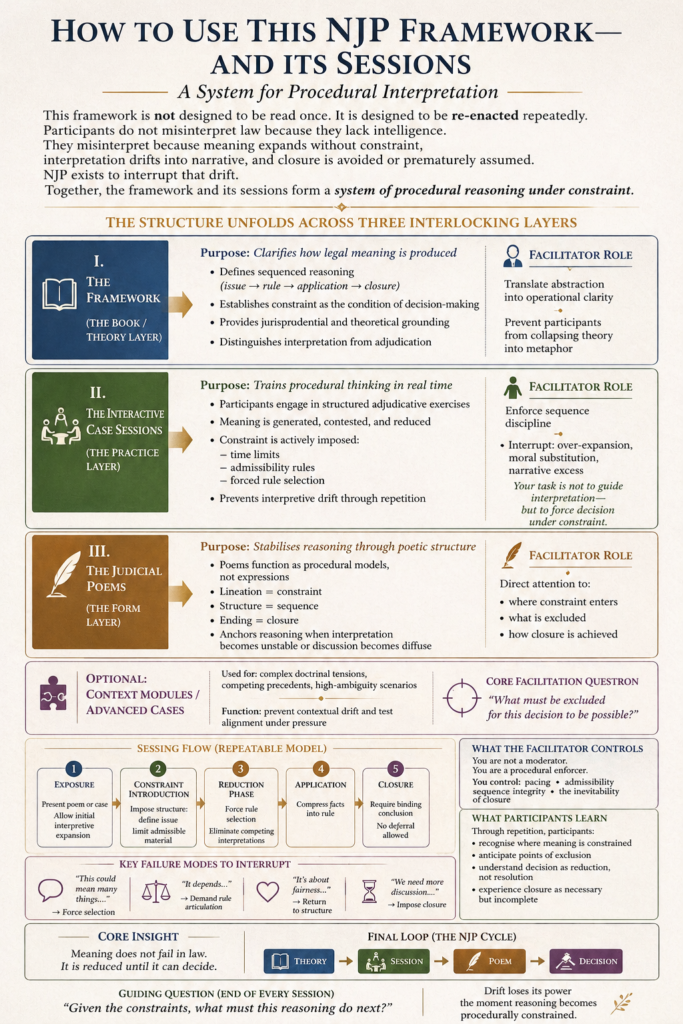
The Mirage of Narrative Coherence
There persists, within the cloistered chambers of legal-humanities discourse, a seduction—an almost liturgical insistence—that law is, at heart, a narrative enterprise: a teller of tales, a weaver of causality, a custodian of moral sequence. One hears the echoes—Cover’s jurisdictional mythos, White’s interpretive rites—each intoning that law speaks in story, that justice itself unfolds as a kind of authored inevitability.
Yet this is a misprision of origin, a reversal of the sacred order.
Law does not begin in narrative. It arrives there—belated, burnished, and already complicit in its own concealments.
The judgment—that august pronouncement we are trained to revere—is not the genesis of coherence but its afterlife. It is the site where fracture is denied, where procedural dismemberments are sutured into the illusion of seamless thought. Narrative, then, is not the engine of legal cognition but its shadow: a retrospective hymn sung over the bones of excision.
What precedes this hymn is no gentle unfolding of story, but a harsher ritual—constraint, sequence, exclusion. A choreography of narrowing apertures.
At each stage—Issue, Rule, Application, Conclusion—the field of possibility is not explored but diminished. The Issue banishes the inconvenient. The Rule enthrones one doctrine while exiling its rivals. The Application disciplines meaning, curbing its insurgent tendencies. The Conclusion seals the chamber against ambiguity, pronouncing finality where uncertainty once breathed.
Thus, what we call narrative is born only after the act of erasure is complete.
Neo-Juridical Poetics refuses this sanctification of order. It names, without flinching, the quiet violence embedded in this procession—the epistemic bloodletting masked as clarity, the tyranny of coherence dressed in the robes of reason.

Case Study Three
Uncover foundational ideas blending verse with jurisprudence.
Beyond Metaphor: Neo‑Juridical Poetics and the Collapse of Posner’s Law and Literature Critique
Abstract
Richard Posner’s critique of the law‑and‑literature movement rests on a foundational assumption: that poetry can illuminate law only metaphorically, never jurisprudentially. This article argues that Neo‑Juridical Poetics (NJP) collapses that assumption by demonstrating that poetic form can perform legal reasoning, articulate doctrine, and expose the metaphysical and ethical dimensions of adjudication. Drawing on case‑driven poetic reconstructions—“The Summons in the Silence,” “The Weight of What We’ve Always Done,” and “The Chain of Guilt”—as well as the principle‑driven poetics of “Bonae Fidei: A Metaphysical Discourse,” this article shows that NJP is not allegorical but adjudicative. It further argues that narrative itself functions as jurisprudential evidence, as exemplified by Papachristou v. City of Jacksonville, a case that Posner’s economic pragmatism cannot intellectually absorb. Integrating insights from James Boyd White, Robert Cover, Martha Nussbaum, W. E. B. Du Bois, and Mahmood Mamdani, the article positions NJP as a universal jurisprudential method rather than a diasporic anomaly. Ultimately, NJP emerges as a new genre of legal thought—one that restores law’s narrative, ethical, and metaphysical dimensions beyond the arid logic of Posner’s jurisprudence.
1. Introduction: Posner’s Foundational Assumption
Richard Posner’s jurisprudence is built upon a single, unexamined premise: that law is literal and poetry is metaphorical. This premise underwrites his dismissal of the law‑and‑literature movement, his critique of narrative jurisprudence, and his insistence—most forcefully articulated in Economic Analysis of Law and The Problems of Jurisprudence—that legal reasoning must remain insulated from narrative, emotion, and metaphysical speculation.
In Posner’s view, law is an instrument of efficient social ordering. Its legitimacy derives not from meaning but from utility; not from narrative coherence but from economic rationality. As he famously argues, “literary methods cannot improve legal reasoning,” because literature is expressive, subjective, and ornamental, whereas law is analytic, objective, and instrumental.
Yet this insulation is neither possible nor desirable.
As my earlier essay When Law Forgets Its Story observes:
“Posner’s jurisprudence is a desert meticulously ordered, its dunes shaped by the winds of economic rationality… Yet deserts, as any attentive wanderer knows, conceal subterranean rivers.”
Those subterranean rivers are narrative, symbol, memory, and metaphysical intuition—elements Posner’s framework cannot acknowledge without collapsing its own foundations.
This article argues that Neo‑Juridical Poetics (NJP) exposes the limits of Posner’s critique by demonstrating that poetry can perform legal reasoning. Unlike Milton, Eliot, Pound, Frost, or Auden—whose works treat law as allegory—NJP uses poetic form to articulate doctrine, reconstruct procedural logic, and reveal the ethical and metaphysical dimensions of adjudication.
Consider the opening of “The Summons in the Silence”:
“The paper came—no trumpet, no parade. Its ink, a whisper: ‘You shall come to court.’”
This is not metaphor. It is procedural jurisprudence rendered in verse.
Or the indictment of custom in “The Weight of What We’ve Always Done”:
“He filed his claim—against the weight of what we’ve always done.”
Here, poetic form exposes the doctrinal violence of ab assuetis non fit injuria.
Or the metaphysical interrogation of joint enterprise in “The Chain of Guilt”:
“One hand may strike, yet many bear the blame…”
This is criminal law reasoning, distilled to its ethical core.
NJP does not merely critique Posner’s assumptions. It performs their collapse.
2. Neo‑Juridical Poetics as Procedural and Adjudicative Poiesis
NJP does not use poetry to describe law. It uses poetry to think as law.
A. “The Summons in the Silence” — Procedure in Verse
The poem performs:
service of process
failure to appear
sanctions
forfeiture
Its structure mirrors a judicial opinion. Silence becomes a juridical act:
“No hall of law waits long on one grown faint.”
B. “The Weight of What We’ve Always Done” — Custom as Juridical Logic
The poem reconstructs the doctrine of custom through precedent:
“Smith v. Green, the judge recalled…”
This is doctrinal reasoning, not metaphor.
C. “The Chain of Guilt” — Joint Enterprise Liability
The poem articulates the metaphysics of complicity:
“Can the mind of one, through silence spread?”
This is adjudication in verse.
Posner never anticipated that poetry could perform legal reasoning.
3. Why Posner’s Critique Cannot Reach NJP: Five Compelling Reasons
1. Posner presupposes law as prose; NJP demonstrates law as poiesis.
2. Posner treats poetry as expressive; NJP uses poetry as doctrinal analysis.
3. Posner denies law’s metaphysical dimension; NJP reveals it as inescapable.
4. Posner treats narrative as external; NJP shows narrative is constitutive.
5. Posner assumes poetry cannot clarify doctrine; NJP clarifies doctrine with precision.
Posner’s critique collapses because it was built to attack allegory, not adjudication.
4. Case‑Driven NJP: Poetry as Adjudication
A. Procedural Absence — “The Summons in the Silence”
The poem reveals silence as juridical speech.
B. Customary Harm — “The Weight of What We’ve Always Done”
The poem exposes custom as narrative sediment hardened into doctrine.
C. Collective Guilt — “The Chain of Guilt”
The poem interrogates the metaphysics of liability.
These poems do not describe law; they perform law.
5. Principle‑Driven NJP: Bonae Fidei and Jurisprudential Ethics
The poem begins with a juridical maxim:
“Bonae fidei non congruit de apicibus juris disputare.”
Good faith is not a technical device; it is a metaphysical force:
“It pulses through the veins of jurisprudence…”
Posner reduces good faith to efficiency. NJP restores it as ethical architecture.
6. Narrative as Jurisprudential Evidence: The Papachristou Break
When doctrine collapses, narrative breathes for law.
The Jacksonville ordinance criminalized identity through narrative imposition. The Court responded with a juridical counter‑narrative:
recounting ordinary activities
restoring misrecognized subjects
exposing narrative violence
As your earlier essay states:
“Narrative resuscitates law when law runs out of oxygen.”
Posner cannot explain Papachristou because it violates his anti‑narrative ontology.
7. NJP as Universal Method, Not Diasporic Accident
NJP is not culturally contingent. It is universal because:
all law is narrative
all law is symbolic
all law is metaphysical
all law is interpretive
Diaspora sharpens the insight, but does not create the method. NJP is a jurisprudential technology.
8. Conclusion: NJP as a New Jurisprudential Genre
Law, when stripped of narrative, becomes a desiccated instrument—efficient, perhaps, but hollow. Posner’s jurisprudence exemplifies this aridity. Yet NJP reveals that law’s vitality lies in its narrative, ethical, and metaphysical dimensions.
NJP is not literature invading law. NJP is law revealing its poetic interior.
It is adjudication rendered in verse. It is doctrine distilled into rhythm. It is ethics articulated through metaphor. It is narrative deployed as evidence. It is metaphysics made juridical.
NJP does not decorate law. NJP revives law.
It is the subterranean river beneath Posner’s desert— the current of narrative, ethics, and metaphysics that makes law not only intelligible, but human.
Exploring Justice Within Poetic Narratives
Find insightful explanations to frequent inquiries, guiding your journey through Neo-Juridical Poetics with clarity.
What does it mean to treat poems as legal cases?
Each poem is examined like a case file, inviting interpretation through judicial and poetic lenses.
How can I participate in the interactive deliberations?
Engage as a juror or advocate by joining our workshops and online forums to debate poetic themes.
What themes are explored in the poetic cases?
Our cases delve into ethics, culture, love, and existential questions through creative discourse.
Can I submit my own poem as a case?
Yes, contributions are welcome and reviewed to fit our neo-juridical poetic framework.
Are there resources to help understand the judicial concepts used?
We provide glossaries and essays that clarify legal ideas woven into the poetry.
Is Neo-Juridical Poetics suitable for all experience levels?
Absolutely; our platform welcomes both newcomers and seasoned poetry or law enthusiasts.
Dive into the Intersection of Verse and Law
Judgment as Poiesis: A Neo-Juridical Poetics Invocation
Let us begin, not with the timid handshake of disciplines politely acknowledging kinship, but with a rupture—a tearing of the veil that has too long kept law and literature in adjacent chambers, whispering through metaphors as though afraid of their own shared ancestry. For what stands before us is no mere resemblance, no decorative analogy, but an identity forged in the furnace of human necessity: judgment is poiesis, and poiesis is judgment………………………….. The final court, as ever, is not marble nor oak-panelled. It is the mind that reads, hesitates, and decides.
