
Senior Jurisprudence Analyst
Poetic Framework Facilitator
An expert in blending legal theory with poetic expression, specializing in guiding participants through interactive cases that challenge traditional interpretations and foster dynamic discourse.

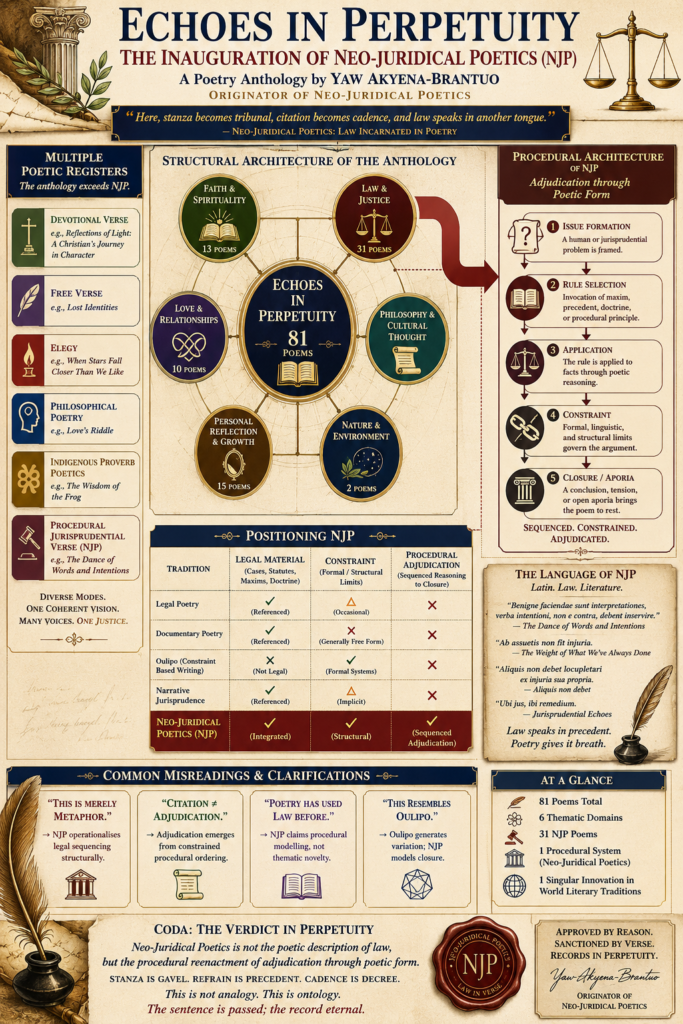
Introduction to ‘Echoes in Perpetuity’
Law, Memory, Cosmos: The Architecture of a Living Anthology
Echoes in Perpetuity is a rare kind of anthology: a work in which poetry becomes jurisprudence, ritual, cosmology, and cultural memory all at once. It is not a collection arranged by convenience but an architecture of thought, built across six interwoven chambers — law, faith, love, nature, philosophy, and personal reflection. Each chamber speaks in its own register, yet all resonate within a shared moral and metaphysical universe.
At the heart of this architecture lies Neo‑Juridical Poetics (NJP), a groundbreaking fusion of legal reasoning and poetic form. In these works, stanza becomes statute, silence becomes summons, and the reader becomes adjudicator. Law is not metaphor but method — a procedural force that interrogates custom, coercion, consent, good faith, and responsibility. The NJP cycle within this anthology — including The Chain of Guilt, The Weight of What We’ve Always Done, Equity’s Path, The Key of Consent, Bonae Fidei, and The Summons in the Silence — has already drawn academic attention for its innovation and intellectual precision. These poems do not merely describe law; they perform it, revealing the paradoxes and ethical tensions that legal doctrine often conceals beneath its polished surface.
Yet the anthology’s emotional gravity lies equally in its explorations of love, ancestry, and cosmology. Here grief becomes a cosmic physics, love becomes philosophical inquiry, and ancestry becomes a living grammar of identity. Poems such as When Stars Fall Closer Than We Like, The Lion Still Roars, and A Bereaved’s Elegy transform mourning into ritual and memory into continuity. Postcolonial critiques like Terroir of Lies expose the semiotics of empire, while spiritual meditations braid faith with daily breath. These works expand the anthology beyond jurisprudence into the realms of metaphysics, cultural inheritance, and existential reflection.
Across its breadth, Echoes in Perpetuity refuses to separate intellect from emotion, law from ritual, or ancestry from futurity. It is a symposium of voices — legal, lyrical, ancestral, metaphysical — bound by a single conviction:
that poetry is not merely to be read, but to be reckoned with.
This anthology invites the reader into a world where justice is a metaphysical force, where memory echoes across generations, and where the self is shaped by both cosmic wonder and earthly struggle. It is a testament to the idea that poetry can hold the weight of law, the tenderness of grief, the fire of resistance, and the quiet pulse of faith — all within a single, resonant continuum.
Echoes in Perpetuity is not simply a book. It is a living archive. A jurisprudential cosmos. A testament to the enduring truth that what we write, remember, and reckon with does not fade — it echoes.
Poems as Cases: Explore Ethical Narratives
Discover a gallery where poetic justice and cultural insights vividly come to life.
Extinguished Firmaments and Resonant Constellations:
Negation, Modulation, and the Metaphysical Acoustics of Grief in W. H. Auden’s Funeral Blues and Y. Akyena-Brantuo’s When Stars Fall Closer Than We Like
I. Prolegomenon: On the Architecture of Mourning
To characterise W. H. Auden’s Funeral Blues as “a secular lament chiselled in negation”, as it is described on page 166 in Echoes in Perpetuity, is to render, in a phrase at once lapidary and diagnostic, the essential tensile structure of its grief. The poem does not supplicate heaven, nor does it seek metaphysical indemnity. It does not rehearse the liturgical grammar of consolation. Instead, it forges an austere monument to loss, sculpted from prohibition and erasure. Its mourning is a command performance addressed to the cosmos: cease, extinguish, dismantle.
By contrast, the elegy When Stars Fall Closer Than We Like inhabits a radically different acoustic chamber. It does not darken the firmament; it repopulates it. It does not silence the orchestra; it modulates its key. Where Auden chisels absence into stone, this poem scores grief as resonance — sustained, dissonant, yet vibratory. The dead do not evacuate the universe; they alter its register.
The comparison between the two poems therefore exceeds stylistic juxtaposition. It implicates divergent ontologies. One imagines grief as terminal negation within a secular cosmos stripped of transcendence. The other imagines grief as transposition — an altered but persistent presence within a universe conceived as resonant field rather than inert void.
This essay undertakes a sustained examination of these competing architectures of mourning: their rhetoric, their cosmology, their metaphysics of sound and silence, their risks of sentimentality, and their philosophical commitments.
II. The Secular Lament: Grief Without Theodicy
Auden’s lament is secular not merely in the absence of God-language but in the structural refusal of redemptive teleology. There is no eschatological horizon against which the beloved’s death might be relativised. The poem offers no metaphysical scaffolding to brace the bereaved. It is grief without theodicy.
The beloved is described as “my North, my South, my East and West,” the very coordinates of orientation. Once that axis is removed, the world ceases to cohere. Grief becomes cosmological dislocation.
The poem’s final assertion — “For nothing now can ever come to any good” — is devastating precisely because it is absolute. It resists mitigation. It repudiates the sentimental reflex that seeks silver linings. The line is an existential verdict.
In this respect, Funeral Blues belongs to a modernist sensibility wary of transcendental assurances. Its secularism intensifies its despair. Without divine recourse, the loss is not merely personal but metaphysical.
III. Chiselled in Negation: The Rhetoric of Prohibition
The poem’s architecture is built upon imperatives. Its opening stanza unfolds as a sequence of commands:
- Stop all the clocks.
- Cut off the telephone.
- Silence the pianos.
- Bring out the coffin.
The syntax is abrupt, declarative, sculpted. Each clause feels hewn rather than poured. This is grief disciplined into linguistic stone.
Negation operates not only grammatically but ontologically. The speaker does not merely describe sorrow; he demands the cessation of function. Time must halt. Communication must cease. Music must fall silent. Even the moon must be packed up; the sun dismantled; the stars extinguished.
Such rhetoric enacts grief as universal erasure. The world, once animated by love, must now conform to its absence. Silence becomes the only adequate aesthetic response.
This chiselled austerity is central to the poem’s power. The language is not florid; it is controlled. Emotion is not diffused but concentrated. The monument stands cold and unadorned.
IV. Cosmic Shutdown: Extinction as Structure
Auden’s imagery scales from domestic to celestial, from clocks and pianos to stars and suns. The progression enacts the expanding radius of loss. Personal grief colonises the cosmos.
The effect is not sentimental amplification but metaphysical indictment. If the beloved constituted the world’s meaning, then his absence voids its justification. The universe becomes surplus matter.
In this cosmology, grief culminates in blackout. The stars, which traditionally signify guidance or continuity, are to be put out. The cosmos offers no consolation; it is to be dismantled as complicit in indifference.
This is extinction as aesthetic structure. Silence is not accidental; it is architectonic.
V. A Counter-Cosmology: Grief as Modulation
When Stars Fall Closer Than We Like commences not with imperative erasure but with accumulation. Mother. Sister. Brother. The grief is layered, iterative. It is described as:
“a long, dissonant chord / Sustained, unresolved.”
The language is musical rather than prohibitive. The grief is not a command to stop but a tension to endure.
The adjective “long” is crucial. It resists sentimental compression. This is not ephemeral sorrow but durational strain. The chord remains unresolved.
Where Auden silences the piano, this poem sustains vibration.
VI. Silence and Sound: Competing Acoustic Philosophies
The acoustic divergence between the poems is philosophically significant.
In Funeral Blues, music is among the first casualties. The piano must be silenced; the drum muffled. Sound, as communal articulation, becomes intolerable in the face of loss. The world must quiet itself to honour absence.
In When Stars Fall Closer Than We Like, music becomes the medium through which grief is articulated. The poem is saturated with musical lexicon:
- Requiem
- Harmony
- Riff
- Bass-stringed heart
- Minor key
- Frequency
Grief is neither denied nor silenced; it is scored. Dissonance is not eradicated but sustained. Even mourning becomes performative:
“Mourn as musicians do.”
Music, unlike silence, permits tension. It allows discord to exist within structure. In this sense, the poem advances a philosophy of grief as modulation rather than annihilation.
The orchestra does not cease; it shifts key.
VII. Frequency and Ontology: The Physics of Presence
Perhaps the most striking conceptual move occurs in the lines:
“He became frequency.
Not absence, but wavelength.”
This is neither orthodox theology nor sentimental afterlife imagery. It invokes the language of physics. Frequency is oscillation — measurable, intangible, persistent. It is presence without materiality.
By adopting this metaphor, the poem reframes death as altered register. The departed does not vanish; he vibrates differently. Memory becomes satellite; love exceeds mass and light-years.
Such imagery tempers consolation with abstraction. It avoids the mawkish trope of angelic surveillance. Instead, it proposes a universe conceived as resonant field.
Where Auden’s cosmos is inert and collapsible, this cosmos is echoing, populated by unseen presences.
VIII. The Risk of Sentimentality and Its Avoidance
Elegy courts sentimentality when it resolves grief too swiftly or beautifies loss without acknowledging rupture. When Stars Fall Closer Than We Like risks this in its celestial imagery — the departed taking residence among constellations. Yet the poem mitigates this risk through specificity: the bereaved is addressed as “man of stars and strings,” a figure already associated with cosmic and musical imagination.
Furthermore, the poem sustains dissonance before offering affirmation. The unresolved chord precedes the Latin crescendo:
Non omnis moriar, sed stellis iterum canam.
The affirmation is not facile. It arises after tension has been acknowledged.
Thus, the poem earns its consolation.
IX. The Latin Crescendo: Defiance Within Tradition
The Horatian echo situates the poem within a classical lineage of poetic immortality. Yet here the declaration is not self-aggrandising but relational. It reframes mortality as transformation within cosmic music.
Against Auden’s terminal verdict — “nothing now can ever come to any good” — this Latin line asserts recurrence. Not resurrection in doctrinal terms, but song in altered sphere.
The gesture is defiant rather than naïve. It refuses extinction without denying grief.
X. Philosophical Divergence: Negation and Transposition
At their cores, the poems articulate divergent ontologies:
- In Auden, love constituted the world; its loss annihilates meaning.
- In When Stars Fall Closer Than We Like, love exceeds the world; its loss alters but does not extinguish meaning.
Auden’s grief is terminal absence.
The contemporary poem’s grief is altered presence.
One chisels despair into marble.
The other composes persistence into vibration.
XI. Conclusion: Two Metaphysical Scores
Both poems are disciplined. Both resist melodrama. Both elevate personal grief into cosmic register. Yet they represent opposing metaphysical commitments.
Auden offers a secular monument to negation — austere, chiselled, devastating. His cosmos darkens in sympathy with loss.
When Stars Fall Closer Than We Like offers a counter-score — one in which the cosmos leans closer, clothed in mourning yet resonant. It acknowledges dissonance yet refuses silence. It imagines death not as erasure but as modulation.
If Auden commands the extinguishing of stars, this poem imagines the stars drawing near.
One ends in blackout.
The other sustains the chord.
And in that sustained vibration — tremulous, unresolved, yet enduring — it locates the possibility that grief, though never annulled, may yet be transposed into song.The poem, “When Stars Fall Closer Than We Like,” can be found on page 193 in the anthology Echoes in Perpetuity.


Where Judicial Wisdom Inspires Poetic Insight
Explore how Neo-Juridical Poetics transforms poetry into living cases, inviting you to engage in ethical, cultural, and existential dialogues through verse.
Neo‑Juridical Poetics: Toward a Procedural Theory of Poetic Form
Abstract
This article advances Neo-Juridical Poetics (NJP) as a decisive reconfiguration of poetic form through the internalisation of jurisprudential procedure. Where earlier literary engagements with law have remained metaphorical—invoking courts, judgments, and statutes as thematic ornaments—NJP treats legal doctrine as generative structure. The poem, in this formulation, becomes a jurisdictional field governed by maxims, constrained by precedent, and propelled through adjudicative sequence. Its authority derives not from lyric intensity alone but from procedural fidelity. Anchored by three exemplary poems— “The Key of Consent,” “The Weight of What We’ve Always Done,” and “The Chain of Guilt”—this essay argues that NJP inaugurates a new mode of literary production in which meaning emerges through disciplined constraint, and where closure may be suspended in a moment of juridical aporia that reassigns judgment to the reader. In so doing, NJP not only redefines poetic form but also reanimates jurisprudence as a living, interpretive art.
1. Introduction: Poetry After Jurisprudence
The long courtship between law and literature has, until now, been conducted in the language of analogy. Judges are said to “read” like poets; poets are said to “argue” like advocates; both are seen as artisans of interpretation. Yet such formulations, however seductive, remain fundamentally superficial. They gesture toward affinity without conceding structural equivalence. They admire the architecture of the other discipline without consenting to inhabit it.
Neo-Juridical Poetics emerges as a rupture in this tradition of polite distance. It does not merely compare poetry to law; it compels poetry to become law—procedurally, structurally, and epistemically. In the work of Yaw Akyena Brantuo, this transformation is neither tentative nor symbolic. It is declarative. The poem is no longer a vessel of feeling that borrows the language of statutes; it is a site of adjudication. It establishes jurisdiction, invokes governing maxims, marshals precedent, and delivers—or withholds—judgment.
Consider, as a point of entry, “The Key of Consent.” The poem does not simply speak about consent; it enacts the legal doctrine beneficium invito non datur as its governing rule:
Consent,
the key
that turns,
unlocks the
door to privileges…
Here, the metaphor of the key is not decorative; it is regulatory. The poem’s progression is bound by the logic of consent: no benefit without volition, no entry without authorisation. The lyric becomes a courtroom in miniature, its lines proceeding not as free associative drift but as disciplined reasoning.
Thus, NJP insists upon a radical proposition: poetry and law are not merely analogous systems of meaning-making; they are structurally homologous. Each depends upon constraint, sequence, and justification. Each seeks to reconcile narrative with rule. And each, at its most rigorous, recognises that authority is not declared—it is earned through procedure.
2. The Limits of Modernist Juridical Allusion
To appreciate the novelty of NJP, one must first reckon with the insufficiencies of its predecessors. Modernist poetry, for all its formal daring, approached law obliquely. It invoked the aura of juridical authority without submitting to its discipline.
In The Waste Land, T. S. Eliot deploys fragments of sacred and quasi-legal injunction—“Datta, Dayadhvam, Damyata”—yet these imperatives command no actionable order. They resonate, but they do not adjudicate. Ezra Pound, in his Cantos, assembles economic grievances with the fervour of a prosecutor, yet his evidence never culminates in a binding judgment. Robert Frost’s “Mending Wall” gestures toward customary law—“Good fences make good neighbours”—but the boundary it describes remains philosophically unstable, its authority perpetually in question.
What unites these gestures is their incompletion. They exhibit:
- Authority without adjudication
- Citation without constraint
- Precedent without procedural necessity
- Boundary without enforceable jurisdiction
Modernism flirted with law but refused its discipline. It opened the door to a juridical aesthetic yet declined to cross the threshold. NJP, by contrast, enters that threshold with full awareness of its demands. It does not merely echo the courtroom; it reconstructs it within the poem.
3. The Jurisprudential Catalyst: Papachristou v. Jacksonville
The conceptual ignition of NJP may be traced to a moment within American jurisprudence: Papachristou v. City of Jacksonville (1972), a case in which the United States Supreme Court invalidated a vagrancy ordinance for vagueness. The decision marked a departure from rigid formalism toward a more narrative-inflected understanding of justice. The Court recognised that law, when stripped of human context, risks becoming arbitrary.
This moment reveals a paradox of enduring significance: law must occasionally become literary to remain just. It must tell stories—of lives, of practices, of movement—if it is to avoid the sterility of abstraction.
NJP reverses this insight. If law may borrow from literature to preserve justice, then poetry may borrow from law to preserve authority. The poem, in this schema, is not diminished by procedural constraint; it is fortified by it. Structure becomes the guarantor of meaning.
4. Jurisdictionality: The Poem as Legal Forum
At the heart of NJP lies the concept of jurisdictionality. Every poem establishes a bounded interpretive domain governed by a specific legal maxim. This maxim is not thematic—it is constitutive. It determines the scope of inquiry and the limits of permissible interpretation.
In “The Key of Consent,” the maxim beneficium invito non datur functions as the poem’s constitutional principle. Every line must conform to its logic. The imagery of the key, the insistence on free will, the rejection of coercion—all are juridically mandated.
Similarly, “The Weight of What We’ve Always Done” is governed by ab assuetis non fit injuria—the notion that long-standing custom may negate claims of harm. The poem constructs a jurisdiction in which precedent accumulates like sediment:
Smith v. Green, the judge recalled…
Then Johnson v. Roberts came to mind…
These cases operate as binding authorities within the poem’s universe. They constrain the narrative, shaping its trajectory toward an inevitable, if unsettling, conclusion. The poem, then, is not a free field of expression; it is a regulated space in which meaning must answer to rule.
5. Procedural Form: Meter as Due Process
NJP reconceives poetic form as procedural architecture. Meter, rhyme, and stanza are no longer aesthetic choices alone; they are functional components of adjudication.
- Meter becomes due process: the regularity that ensures fairness of progression.
- Stanzaic sequencing mirrors legal reasoning: each unit builds upon the last.
- Enjambment enacts negotiation: the tension between continuity and interruption.
- Rhyme operates as doctrinal recurrence: the return of established principles.
In “The Weight of What We’ve Always Done,” each stanza introduces a new precedent, tightening the interpretive frame. The repetition of legal citation mimics the accumulation of case law, creating a rhythm of inevitability. By the time Ellis files his claim, the outcome has already been structurally foreclosed. Form, in NJP, is not ornamental. It is the machinery through which judgment is produced.
6. Precedential Constraint and Adjudicative Movement
An NJP poem unfolds according to a recognisable juridical sequence:
- Presentation of facts
- Identification of the issue
- Invocation of precedent
- Application through reasoning
- Delivery—or suspension—of a holding
This structure is evident in “The Weight of What We’ve Always Done.” The early stanzas establish the facts: unsafe working conditions, inherited practices, a culture of silence. The issue emerges through Ellis’s question: “Isn’t this a risk?” The subsequent stanzas marshal precedent, each case reinforcing the authority of custom. The reasoning becomes increasingly constrictive, until the final stanza delivers its stark conclusion:
Ab assuetis non fit injuria…
What’s customary… may not be wrongful deed.
The poem’s power lies not in its emotional appeal but in its procedural inevitability. It compels assent through structure.
7. Juridical Aporia: The Poem That Refuses to Close
Yet NJP’s most radical gesture is not its capacity for closure but its principled refusal of it. Juridical aporia arises when the governing doctrine produces an irresolvable tension—when to decide would be to violate the very rule that authorises decision.
“The Chain of Guilt” exemplifies this condition. The poem explores joint enterprise liability, asking whether shared intent can render all participants culpable for a single act:
One wielded steel, yet ten would pay the cost…
As the poem progresses, the doctrine tightens its grip. Intent becomes collective; responsibility diffuses. Yet a fracture appears: what of those who did not act? What of silence, of fear, of mere presence?
Shall justice see the silent as the damned?
Here, the poem encounters its limit. To affirm collective guilt risks injustice; to deny it risks impunity. The doctrine cannot resolve its own contradiction.
And so the poem halts. It refuses closure. It transfers the burden of judgment to the reader, who must now assume the role of juror. This is not ambiguity in the modernist sense; it is a procedural impasse. The poem ends where the law cannot proceed.
8. Case Studies: NJP in Practice
Taken together, the three poems form a triptych of NJP’s possibilities.
- “The Key of Consent” demonstrates jurisdictional clarity: a single maxim governs the entire structure.
- “The Weight of What We’ve Always Done” illustrates precedential accumulation: meaning emerges through the layering of authority.
- “The Chain of Guilt” reveals the frontier of aporia: the point at which law’s logic collapses into ethical uncertainty.
Each poem enacts law rather than describing it. Each transforms doctrine into form.
9. Positioning NJP Within Literary History
NJP occupies a singular position within literary history. It is not a continuation of modernism, though it inherits its formal ambition. Nor is it a branch of postmodernism, though it shares its scepticism toward absolute closure. It is, rather, a procedural aesthetic that draws upon jurisprudence as its primary analogue.
Its intellectual lineage includes figures such as Ronald Dworkin, whose theory of “law as integrity” emphasises coherence and fit, and Robert Cover, who recognised the narrative dimensions of legal meaning. Yet NJP extends these insights into the realm of poetic form, forging a synthesis that is both rigorous and generative.
10. Conclusion: Toward a Procedural Poetics
Neo-Juridical Poetics proposes a redefinition of poetic authority. No longer grounded solely in the intensity of expression, authority emerges through adherence to rule, through the disciplined unfolding of procedure.
In this new paradigm, the poem is a court, the maxim a statute, the stanza a step in reasoning, and the reader a juror entrusted with judgment. Meaning is not given; it is adjudicated.
And in those moments where adjudication fails—where doctrine falters under the weight of its own contradictions—the poem does not collapse. It stands, suspended, demanding of its reader the courage to decide.
Thus, NJP offers not merely a new style of poetry but a new conception of what poetry can be: a site where law and language converge, where structure and story coalesce, and where the pursuit of meaning becomes, at last, a matter of justice.

Case Study One
Delve into a poetic case that intertwines ethics with lyrical expression, challenging perceptions.

Case Study Three
Experience a unique narrative where love and legality merge in a thoughtful poetic trial.

Case Study Five
Engage with a profound exploration of existence framed as a judicial poem, inviting reflection.