

Description
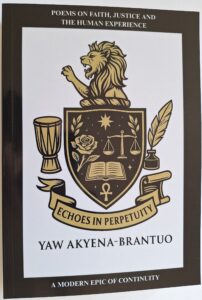
Echoes in Perpetuity is a rare literary event — a bold fusion of poetry, jurisprudence, spirituality, and ancestral wisdom that reshapes what verse can be. In this groundbreaking anthology, Yaw Akyena‑Brantuo inaugurates Neo‑Juridical Poetics, a genre in which stanza becomes statute, proverb becomes precedent, and the poem itself becomes a site of judgment, meditation, and moral reckoning.
Across six sweeping thematic fields — Faith, Justice, Love, Nature, Personal Reflection, and Cultural Philosophy — the collection traverses the landscapes of human experience with intellectual precision and spiritual depth. Biblical echoes, Ga and Twi proverbs, and the rigour of case law converge to form an aesthetic that is as contemplative as it is confrontational.
These poems do not merely describe justice; they interrogate it. They do not simply gesture toward faith; they inhabit its tensions. They do not treat African wisdom as ornament; they elevate it to epistemic authority. In a world saturated with noise, Echoes in Perpetuity offers a sanctuary of thought — a place where language slows, deepens, and demands engagement.
This is poetry as archive, as tribunal, as philosophical compass. It is a work that challenges the reader not only to feel, but to think; not only to witness, but to reckon. Akyena‑Brantuo’s voice is both ancestral and innovative, weaving a tapestry where law’s cold stone and poetry’s living breath are smelted into a single, resonant alloy.
A visionary contribution to contemporary literature, Echoes in Perpetuity is not simply read — it is studied, cited, and lived.
What Each Poem Contributes to the Anthology
A Thematic Table of Function and Meaning
Faith & Spirituality (13 poems)
| Poem | What It Contributes to the Anthology |
| The Light of Bethlehem | Establishes the spiritual tone; frames faith as illumination and moral orientation. |
| Communion: A Journey of Faith | Explores spiritual intimacy and collective identity; deepens the anthology’s contemplative core. |
| Journey Through Wisdom’s Garden | Introduces metaphysical growth; bridges spirituality with philosophical inquiry. |
| Reflections of Light | Examines Christian character formation; reinforces moral introspection. |
| The Jewel of Thought | Connects biblical ethics with cognitive discipline; anchors the anthology’s epistemic dimension. |
| Beacons of Faith | Reclaims biblical heroines as moral exemplars; expands spiritual representation. |
| The Sacred Rite | Highlights ritual as moral architecture; reinforces reverence. |
| Stewards of the Divine | Introduces themes of responsibility and transient ownership; links faith to ethics. |
| Echoes of Humility | Grounds the anthology in metaphysical modesty; tempers legal authority with spiritual humility. |
| The Critic’s Gem | Reflects on judgment and discernment; foreshadows legal themes. |
| Echoes of the Messenger | Connects prophetic tradition to contemporary moral duty. |
| The Compass Within | Frames conscience as internal jurisprudence; bridges faith and justice. |
| The Radiance of Grace | Concludes the section with spiritual generosity; softens the anthology’s juridical edge. |
Law & Justice (31 poems)
| Poem | What It Contributes |
| Good Friday | Merges legal injustice with theological sacrifice; inaugurates Neo‑Juridical Poetics. |
| The Summons in the Silence | Explores coercion and unspoken power; deepens the anthology’s critique of authority. |
| Maxim’s Echo | Introduces Latin maxims as poetic refrain; formalises the genre’s legal cadence. |
| The Weight of What We’ve Always Done | Critiques custom as tyranny; central to the anthology’s jurisprudential argument. |
| Jurisprudential Echoes | Reflects on precedent as cultural memory; reinforces law-as-poetry. |
| Trespasser Ab Initio | Uses case law to explore moral contamination; sharpens legal metaphor. |
| The Chain of Guilt | Examines collective responsibility; expands legal inquiry into social ethics. |
| Journey to Justice | Humanises legal struggle through immigrant experience; adds narrative depth. |
| Threads of Goodness | Introduces moral equity; tempers strict legality. |
| Ab Initio | Revisits foundational wrongdoing; reinforces legal Latin as poetic structure. |
| Verba Illata | Explores intention vs. expression; central to the anthology’s linguistic jurisprudence. |
| Cosmic Justice | Expands justice beyond human courts; introduces metaphysical law. |
| Echoes of Justice | Synthesises humility and legal authority; a philosophical anchor. |
| Dulce Bellum Inexpertis | Critiques war through legal ethics; widens the anthology’s moral scope. |
| Commerce in Verse | Examines transactional integrity; links law to everyday morality. |
| Aliquis Non Debet | Reinforces fairness as legal and ethical principle. |
| Celestial Justice | Merges divine order with legal reasoning; strengthens metaphysical jurisprudence. |
| Scales of Justice | Symbolic centrepiece; articulates balance as moral necessity. |
| The Key of Consent | Explores autonomy and coercion; crucial to the anthology’s ethical argument. |
| The Dance of Words and Intentions | A masterwork of linguistic jurisprudence; defines Neo‑Juridical Poetics. |
| Equity’s Path | Introduces fairness as corrective justice; softens strict legalism. |
| Baratriam Committit | Condemns corruption; reinforces law’s moral backbone. |
| Ghosts of Liberty | A narrative of coercion and freedom; emotionally anchors the justice section. |
| The Scribe’s Intent | Reflects on authorship and authority; meta‑juridical. |
| Sanctity of Thoughts | Explores mental privacy; anticipates modern legal dilemmas. |
| Clarity Beyond Shadows | Examines truth-seeking; reinforces epistemic justice. |
| In Realms of Testament | Explores legacy and intention; ties law to mortality. |
| The World of Caveat Emptor | Critiques market ethics; expands legal inquiry into commerce. |
| Along the Banks of Milton Creek | Grounds justice in place and memory; adds localised texture. |
Love & Relationships (10 poems)
| Poem | Contribution |
| Life’s Dance | Humanises the anthology; introduces emotional jurisprudence. |
| The Bereaved’s Elegy | Explores grief as moral experience. |
| Shattered Echoes, Rising Sun | Introduces resilience through loss. |
| Terroir of Lies | Examines identity and misrepresentation; links love to politics. |
| Explored in a Perspective of Peace | Offers reconciliation; softens emotional conflict. |
| The Lion Still Roars | Celebrates ancestry; ties love to heritage. |
| A Condolence in the Key of Ancestry | Merges mourning with cultural continuity. |
| When Stars Fall Closer | Explores vulnerability; deepens emotional range. |
| Love’s Riddle | Introduces philosophical intimacy. |
| Oneness in Diversity | Connects love to social harmony; broadens relational ethics. |
Nature & Environment (2 poems)
| Poem | Contribution |
| Nature’s Silent Symphony | Introduces ecological consciousness; expands the anthology’s moral terrain. |
| Cosmic Consciousness Unveiled | Connects nature to metaphysics; reinforces cosmic justice. |
Personal Reflection & Growth (15 poems)
| Poem | Contribution |
| Navigating the Labyrinth | Explores identity as journey; deepens introspection. |
| The Akan Wisdom | Introduces indigenous philosophy; anchors cultural authority. |
| Aliquando Dormitat | Reflects on human fallibility; ties humility to growth. |
| Ad Captandum Vulgus | Examines persuasion; links rhetoric to ethics. |
| Lost Identities | Explores fragmentation; ties personal loss to cultural erosion. |
| Along the Banks of Milton Creek | Grounds reflection in place; adds autobiographical resonance. |
| Time’s Torment | Introduces temporal anxiety; deepens existential themes. |
| Life’s a Journey | Celebrates becoming; reinforces resilience. |
| Time and Change | Explores impermanence; ties growth to acceptance. |
| The Dance of Time | Philosophical reflection on continuity; expands temporal themes. |
| Eternal Echoes | Tribute poem; connects memory to legacy. |
| Invincible | Celebrates resilience; anchors motivational tone. |
| Lessons from the Plough | Uses agrarian metaphor; reinforces ancestral ethics. |
| Courage Amidst Uncertainty | Encourages moral bravery; ties personal growth to justice. |
| Embracing Truth and Power | Explores authenticity; deepens psychological insight. |
Philosophy & Cultural Thought (11 poems)
| Poem | Contribution |
| The Wisdom of the Frog | Introduces metaphysical minimalism; anchors indigenous philosophy. |
| The Dance of Flame and Powder | Explores harmony and conflict; expands ethical inquiry. |
| The Pursuit of Contentment | Critiques materialism; central to cultural ethics. |
| In the Elephant’s Trail | Uses animal metaphor; reinforces communal wisdom. |
| The Hunter’s Resolve | Explores discipline and purpose; ties culture to virtue. |
| The Generous Sleeps by the Wayside | Examines generosity and vulnerability; deepens moral nuance. |
| Respecting Life’s Stages | Explores age and wisdom; reinforces cultural continuity. |
| Wisdom’s Echo | Synthesises ancestral knowledge; philosophical centrepiece. |
| Hu m’ani so ma me nti… | Uses Twi proverb; asserts indigenous epistemic authority. |
| Friendly Fire | Explores internal conflict; ties psychology to culture. |
| “I” | Philosophical meditation on selfhood; closes the anthology’s reflective arc. |


Reviews
There are no reviews yet.